Tangible evidence from the future
I used AI to design a fake product from 2050: a pillow that simulates a deceased child’s heartbeat. By creating realistic IKEA-style ads and marketplace listings, I forced doctors to confront uncomfortable ethical dilemmas. Here is how speculative design turns fiction into a reality check.
Category:
Speculative Design
Author:
Pavel Danyi
Read:
11 mins
Location:
Prague
Date:
July 21, 2025
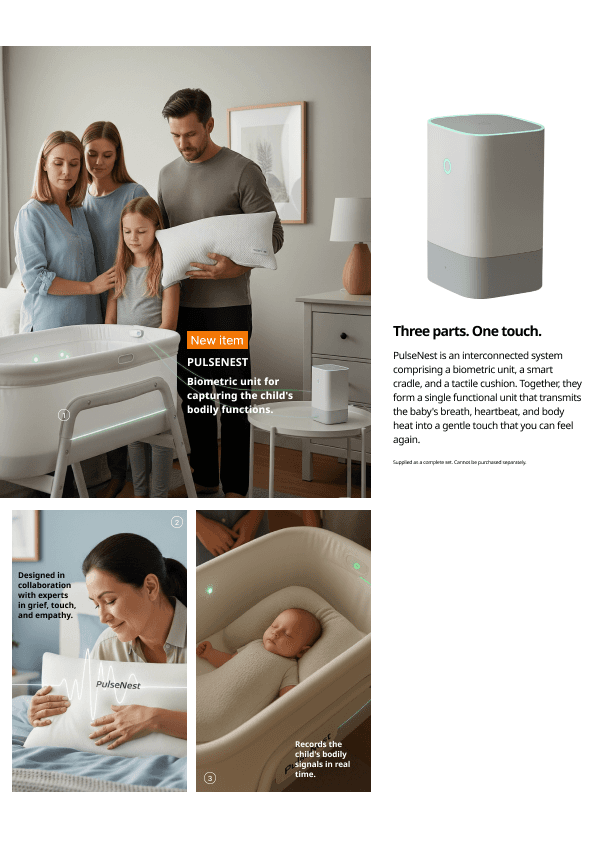
What is Speculative Design? (From an IKEA Catalog to a Marketplace Ad)
What is Speculative Design? (From an IKEA Catalog to a Marketplace Ad)
The brief wasn't simply "create an illustration." My task was to apply the method of speculative design. The goal of this method isn't to predict the future, but to materialise possible scenarios – often controversial ones – so we can discuss them before they become reality.
In the course of our collaboration, I generated dozens of different variants and artifacts, from wearables to digital services. For the purpose of this article, however, I will focus on one specific concept that elicited the strongest reactions – the PulseNest.
Roman Sellner and Natálie Káčová provided me with a scenario of the world in 2050, where technology in the care of grieving parents is a common commodity. My task was to create a believable ecosystem for this world. It wasn't enough to just create a product. I had to show its entire life cycle: how it is sold, how it is reported in the news, and what happens to it when no one wants it anymore.
The power of speculative design lies in its banality. If the artifacts looked like props from Black Mirror, the viewer could easily dismiss them as unrealistic. But if they look like something that pops up in your morning news feed or on Facebook, the defense mechanisms crumble, and a sense of chilling unease sets in.
Phase 1: The Commodification of Grief (The Catalog)
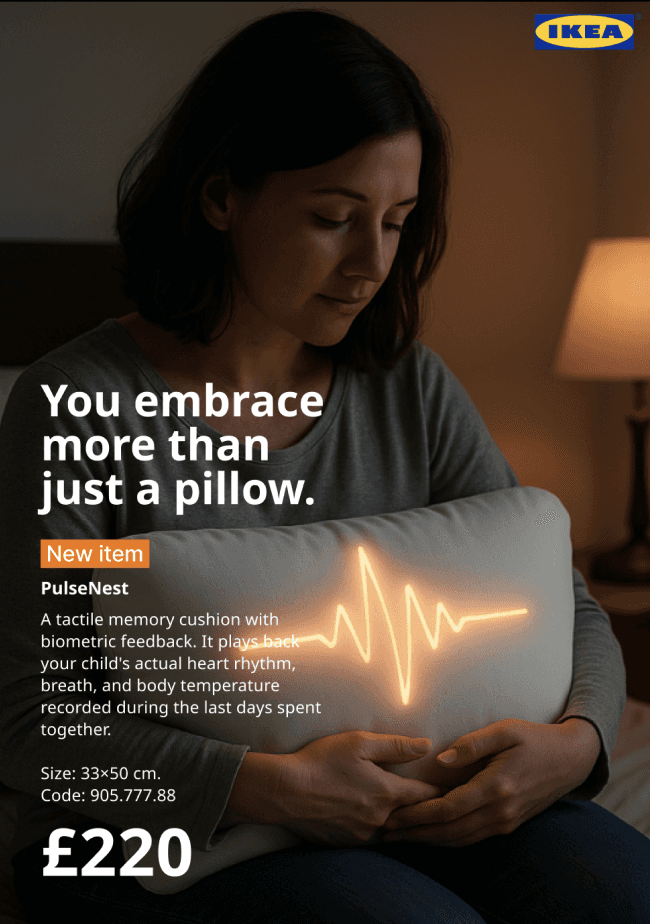
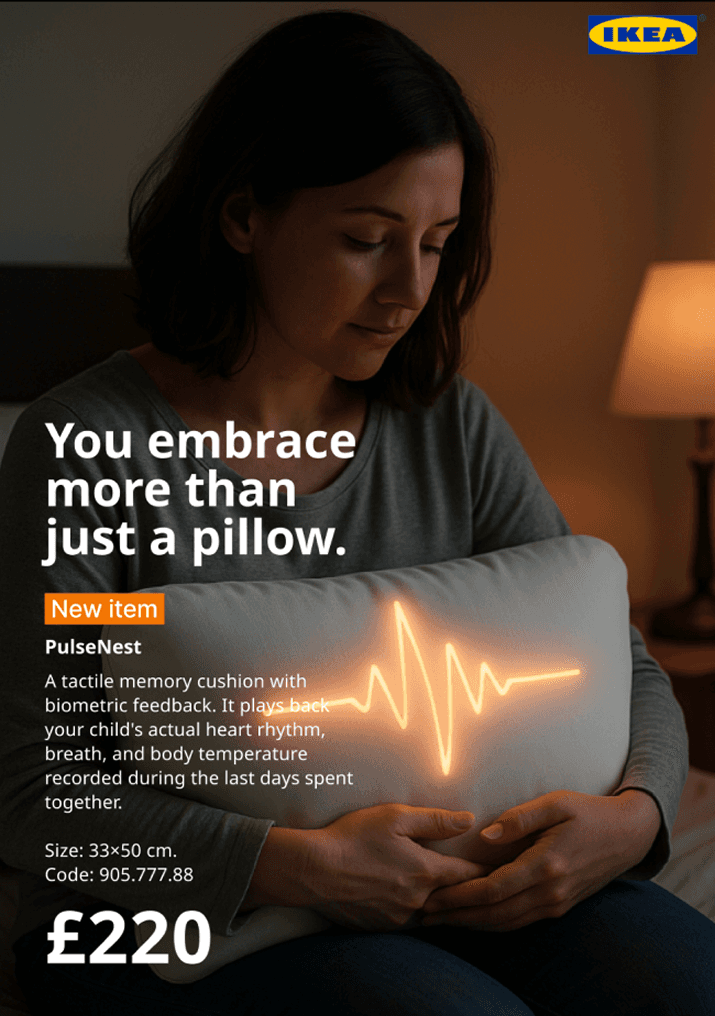
The first step was to create a product that promises comfort. I placed the PulseNest artifact within the aesthetic of a department store catalog.
Fig. 1: PulseNest in the aesthetic of a global retail chain. The visual combines a homely atmosphere with a technological description of a product that "plays back the actual heart rhythm and breath of your child." The £990 price tag adds a terrifying reality – grief becomes an item in a shopping cart.
Phase 2: Institutionalization (News 2050)
For the world to be believable, society must react to technology. Therefore, I created a fictional article from the iDNES.cz news server dated 2050.
Fig. 2: Fictional article "PulseNest Enters Czech Hospitals." The text simulates public debate – quoting enthusiastic ministry spokespeople as well as skeptical psychologists warning against "pathological mourning." This artifact demonstrates how such technology would be normalized in the public space.
Phase 3: Waste and Forgetting (Marketplace)
The most chilling part of my work was the visual showing the end of the product's life cycle. What happens to a pillow that simulates the heartbeat of a dead child when the parents no longer want it?
Fig. 3: Ad on Facebook Marketplace. The text "Selling our PulseNest, we no longer need it" for 5,000 CZK is a brutal collision of sacred grief and banal consumerism. It shows the moment when a "tool of love" becomes "used goods" that need to be discarded.
Methodology: battling AI and finding "The Uncanny"
Although the result may look simple, the path to it was long. My main tool was generative artificial intelligence (Perplexity for context, ChatGPT/DALL-E 3 and Gemini for visuals), but it wasn't a "one-click" job.
It was more of a battle with the algorithm. I generated hundreds of variants and variations, testing different styles and compositions. AI tends to generate "pretty" and "happy" people from stock photos. My task was to force it to generate an emotion that is much more complex: a mixture of hope, pain, and shame.
Case study: The evolution of a prompt
What does the search for the right expression look like for a mother using such a product? Here is an example of how I had to iterate the assignment (prompt) to get from kitsch to something that works.
Attempt No. 1 (Failure): Prompt: "Sad mother looking at a computer screen with an avatar of a child, futuristic style, blue light." Result: Too theatrical, too "cinematic." The character was looking directly at the viewer, which felt like a cry for help. It lacked intimacy and believability.
Attempt No. X (Dead End): Prompt: "Product photography, realistic lifestyle shot. A woman sitting at a kitchen table. Looking at a tablet. Warm lighting." Result: Too cozy. It looked like an advertisement for video calls. The uncomfortable ethical contradiction was missing.
Attempt No. 42 (Final Version): Prompt: "Cinematic shot, hyper-realistic. Over-the-shoulder view of a tired woman looking at a tablet screen. The woman is NOT looking at the camera; she is avoiding eye contact, looking down, expression is a mix of comfort and deep shame. Soft, cold morning light. Commercial aesthetic but with a dystopian undertone." Result: Only here did I manage to hit the key emotion – shame. The woman avoids eye contact because she knows what she is doing is socially unacceptable, but she can't help herself. It was this detail, fought for through dozens of attempts, that gave the artifact its believability.
Impact: When Design Causes Terror
Since I was working remotely, I had no direct contact with the workshop participants (healthcare professionals and experts). I often doubted whether mere pixels sent over the internet carried any weight. The true impact of this method only hit me when listening to the podcast Ministerský jednorožec (The Ministerial Unicorn), where psychotherapist Kateřina Hájková Klíčová reflected on the participants' reactions to these very visuals.
The artifacts worked exactly according to the definition of speculative design – they induced an "ethical shock." Participants did not react to the aesthetics, but to the terrifying availability of these technologies. As stated in the podcast:
"I see terror in your eyes. Speculative design can do that. [...] Only when we go through that shock can we then ask: What will we, as humans, do about it?" [^1]
When the healthcare professionals saw the catalog with the PulseNest pillow, their first reaction was rejection: "We don't want this, let's go back to bonfires." And that was exactly the goal. Thanks to these artifacts, they were able to experience a "dry run" of a situation where a parent comes to them requesting such technology. We created a safe simulator for dilemmas that await us.
Conclusion
This collaboration, the door to which was opened by my studies at KISK, confirmed to me that design doesn't just have to "solve problems." It can and should also open them. Visual narration supported by AI allows us to "touch" the future and decide whether we want it, before it's too late. I am continuing the project with Roman Sellner and Natálie Káčová because the ability to visualize invisible threats is proving to be a key competence for modern healthcare and society.
Sources
Bibliography:
Pavlovská, Veronika, and Kateřina Hájková Klíčová. "Care and Support for Healthcare Personnel, Systems Change, and Speculative Design." Ministerský jednorožec. Podcast, audio, 53:00. November 20, 2024.
[^1]: Pavlovská, Veronika, and Kateřina Hájková Klíčová. "Care and Support for Healthcare Personnel, Systems Change, and Speculative Design." Ministerský jednorožec. Podcast, audio, November 20, 2024. Available at: https://feeds.transistor.fm/ministersky-jednorozec
What is Speculative Design? (From an IKEA Catalog to a Marketplace Ad)
The brief wasn't simply "create an illustration." My task was to apply the method of speculative design. The goal of this method isn't to predict the future, but to materialise possible scenarios – often controversial ones – so we can discuss them before they become reality.
In the course of our collaboration, I generated dozens of different variants and artifacts, from wearables to digital services. For the purpose of this article, however, I will focus on one specific concept that elicited the strongest reactions – the PulseNest.
Roman Sellner and Natálie Káčová provided me with a scenario of the world in 2050, where technology in the care of grieving parents is a common commodity. My task was to create a believable ecosystem for this world. It wasn't enough to just create a product. I had to show its entire life cycle: how it is sold, how it is reported in the news, and what happens to it when no one wants it anymore.
The power of speculative design lies in its banality. If the artifacts looked like props from Black Mirror, the viewer could easily dismiss them as unrealistic. But if they look like something that pops up in your morning news feed or on Facebook, the defense mechanisms crumble, and a sense of chilling unease sets in.
Phase 1: The Commodification of Grief (The Catalog)
The first step was to create a product that promises comfort. I placed the PulseNest artifact within the aesthetic of a department store catalog.
Fig. 1: PulseNest in the aesthetic of a global retail chain. The visual combines a homely atmosphere with a technological description of a product that "plays back the actual heart rhythm and breath of your child." The £990 price tag adds a terrifying reality – grief becomes an item in a shopping cart.
Phase 2: Institutionalization (News 2050)
For the world to be believable, society must react to technology. Therefore, I created a fictional article from the iDNES.cz news server dated 2050.
Fig. 2: Fictional article "PulseNest Enters Czech Hospitals." The text simulates public debate – quoting enthusiastic ministry spokespeople as well as skeptical psychologists warning against "pathological mourning." This artifact demonstrates how such technology would be normalized in the public space.
Phase 3: Waste and Forgetting (Marketplace)
The most chilling part of my work was the visual showing the end of the product's life cycle. What happens to a pillow that simulates the heartbeat of a dead child when the parents no longer want it?
Fig. 3: Ad on Facebook Marketplace. The text "Selling our PulseNest, we no longer need it" for 5,000 CZK is a brutal collision of sacred grief and banal consumerism. It shows the moment when a "tool of love" becomes "used goods" that need to be discarded.
Methodology: battling AI and finding "The Uncanny"
Although the result may look simple, the path to it was long. My main tool was generative artificial intelligence (Perplexity for context, ChatGPT/DALL-E 3 and Gemini for visuals), but it wasn't a "one-click" job.
It was more of a battle with the algorithm. I generated hundreds of variants and variations, testing different styles and compositions. AI tends to generate "pretty" and "happy" people from stock photos. My task was to force it to generate an emotion that is much more complex: a mixture of hope, pain, and shame.
Case study: The evolution of a prompt
What does the search for the right expression look like for a mother using such a product? Here is an example of how I had to iterate the assignment (prompt) to get from kitsch to something that works.
Attempt No. 1 (Failure): Prompt: "Sad mother looking at a computer screen with an avatar of a child, futuristic style, blue light." Result: Too theatrical, too "cinematic." The character was looking directly at the viewer, which felt like a cry for help. It lacked intimacy and believability.
Attempt No. X (Dead End): Prompt: "Product photography, realistic lifestyle shot. A woman sitting at a kitchen table. Looking at a tablet. Warm lighting." Result: Too cozy. It looked like an advertisement for video calls. The uncomfortable ethical contradiction was missing.
Attempt No. 42 (Final Version): Prompt: "Cinematic shot, hyper-realistic. Over-the-shoulder view of a tired woman looking at a tablet screen. The woman is NOT looking at the camera; she is avoiding eye contact, looking down, expression is a mix of comfort and deep shame. Soft, cold morning light. Commercial aesthetic but with a dystopian undertone." Result: Only here did I manage to hit the key emotion – shame. The woman avoids eye contact because she knows what she is doing is socially unacceptable, but she can't help herself. It was this detail, fought for through dozens of attempts, that gave the artifact its believability.
Impact: When Design Causes Terror
Since I was working remotely, I had no direct contact with the workshop participants (healthcare professionals and experts). I often doubted whether mere pixels sent over the internet carried any weight. The true impact of this method only hit me when listening to the podcast Ministerský jednorožec (The Ministerial Unicorn), where psychotherapist Kateřina Hájková Klíčová reflected on the participants' reactions to these very visuals.
The artifacts worked exactly according to the definition of speculative design – they induced an "ethical shock." Participants did not react to the aesthetics, but to the terrifying availability of these technologies. As stated in the podcast:
"I see terror in your eyes. Speculative design can do that. [...] Only when we go through that shock can we then ask: What will we, as humans, do about it?" [^1]
When the healthcare professionals saw the catalog with the PulseNest pillow, their first reaction was rejection: "We don't want this, let's go back to bonfires." And that was exactly the goal. Thanks to these artifacts, they were able to experience a "dry run" of a situation where a parent comes to them requesting such technology. We created a safe simulator for dilemmas that await us.
© Visual Journal ジャーナル
(WDX® — 02)
Creative Notes
More Article©
© Visual Journal ジャーナル
(WDX® — 02)
Creative Notes
More Article©

Lenka Hámošová: We need to Increase AI literacy. We cannot avoid manipulation.
Interview with AI profesionals
How do we recognize original design in a world saturated by AI? Lenka Hámošová, a respected visual artist and researcher, reflects on current trends in design where artificial intelligence plays an increasingly significant role. Specializing in synthetic media and AI in art, Lenka discusses the challenges of identifying original work in the AI era and offers a perspective on how to navigate this rapidly evolving environment.
© Visual Journal ジャーナル
(WDX® — 02)
Creative Notes
More Article©
© Help Center
(WDX® — 01)
Clarifications
© Help Center
(WDX® — 01)
Clarifications
© Help Center
(WDX® — 01)
Clarifications
FAQ.

Defining outcomes through a transparent process and honest dialogue.
01
What services do you offer?
02
What is your typical process?
03
How do you identify what users truly need?
04
Why invest in research instead of jumping straight into design?
05
What is your primary goal when designing an interface?
06
What exactly is the "output" of your work?
What services do you offer?
What is your typical process?
How do you identify what users truly need?
Why invest in research instead of jumping straight into design?
What is your primary goal when designing an interface?
What exactly is the "output" of your work?