
Wellbeing
for Digital Nomads
Addressing the "dark side" of the digital nomad lifestyle. The target audience faces a specific type of isolation and instability that standard wellness apps cannot solve. The core problem is the absence of deep human connections and the lack of a safety net during crises in foreign countries. The challenge was to design a service ecosystem that restores stability and acts as a preventative measure against mental breakdown.
Year:
2025 – 2026
Category:
Service Design / UX & UI
Client:
Concept proposal
Duration:
🟢 12 weeks (Ongoing)
Location:
DaNang/Vietnam, Denpasar/Indonesia
Tools:
Miro, Notion, Figma, FigJam, Google Suite, Typeform, Teams
Design process:
Design Thinking, Double Diamond
Wellbeing
Support
Mental Health
Experience
The project itself :
The context
The Context Southeast Asian hubs like Da Nang and Bali are often romanticised as paradise. The reality for many digital nomads, however, is chronic isolation and burnout. Without the safety nets of home (family, long term friends), they face a silent mental health crisis. While physical activity is a key coping mechanism, the anxiety and effort required to navigate local rental logistics often prevent them from taking that first step into the water.
Hypothesis:
I believe that for digital nomads, the barrier to physical wellbeing is not logistical, but psychological. The complete absence of a support network (friends, family, safety net) creates a state of paralysis, where the fear of vulnerability prevents them from engaging in the restorative activities they desperately need.
Goal:
To design a systemic support structure for isolated nomads. The primary goal is to identify and define a solution that fills the void of a missing social network, acting as a reliable safety net that systematically supports their mental and physical wellbeing without the need for a human partner.
My role:
Solo UX/Product Designer responsible for the end to end process, from service design concepts and user flows to the final UI and safety feature integration.
Responsibilities:
Kick-off canvas
Desk research
Stakeholder Mapping
In-depth Interviews
Affinity diagram
Persona
Value proposition Canvas
Point of view (POV)
How might we (HMW) Brainstorming
Impact/Effort Matrix
Service prototyping
Service blueprint
Usability testing
Touchpoint design
Implementation guide
Feedback loops
Unmasking the Crisis
Discovery
I initiated the process with consultations from design mentors and a mental health professional to establish ethical and safety boundaries, followed by desk research
and in depth interviews, which I then synthesised using affinity mapping into data driven personas.
Expert consultation
Before entering the field, I validated the design challenge with my Mentors to ensure the project scope was strategically sound. Simultaneously, I consulted a Mental Health Professional to gain critical domain knowledge regarding high-functioning depression and suicide prevention protocols.
"Never facilitate alone. Ensure a mental health professional is present to handle potential participant breakdowns."
Mgr. Roman Sellner Novotný, Ph.D.,
Research Consultant.
"Researcher safety comes first. Consult a therapist to clear your own headspace before opening sensitive topics with users."
Mgr. Tereza Kosnarová,
Service designer, facilitator, and certified accessibility specialist.
"Challenge your confirmation bias. Don't enter the field expecting tragedy; validate the reality, not your fears."
Mgr. Alexandr Kasal, Ph.D.,
Researcher at National Institute of Mental Health.
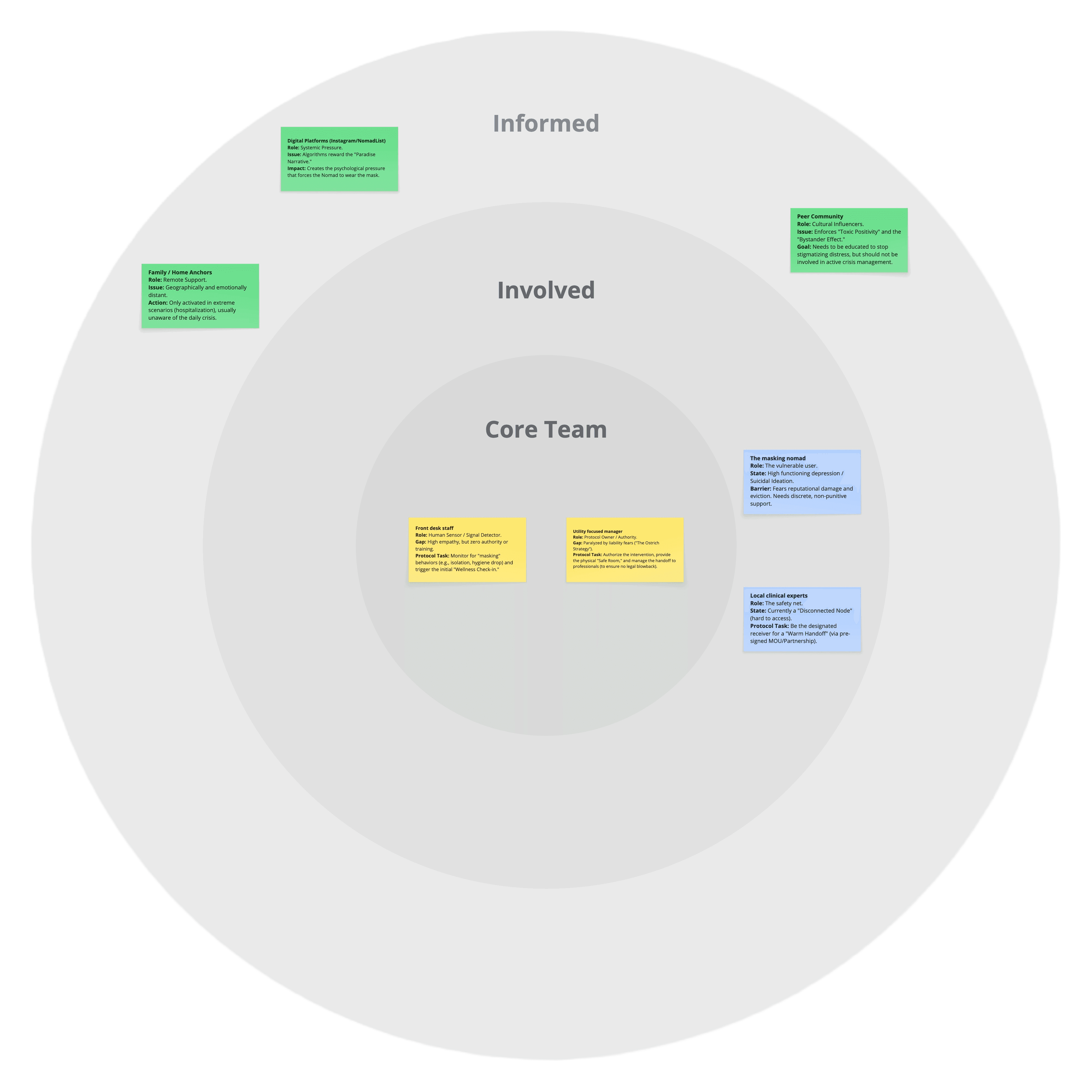
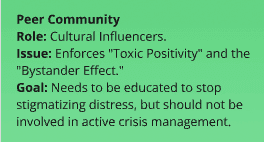
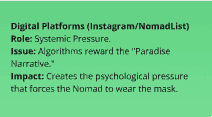
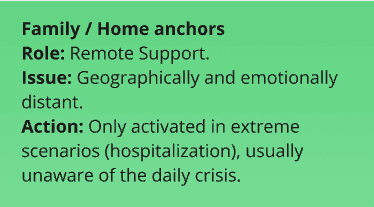
Stakeholder mapping
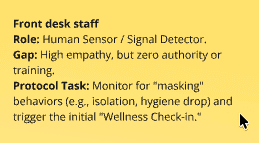
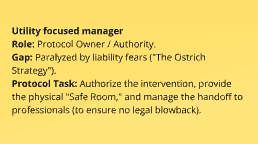
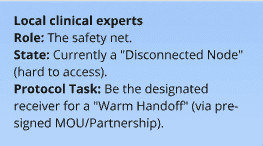
I initiated this mapping to stop guessing and uncover the real connections directly in the field. Having navigated the ecosystem, I arrived at this validated map. I now know exactly who the stakeholders are and what their actual pain points are.
Coworking infrastructure pulse
To validate the systemic side of the problem, I distributed a quantitative survey to management across 10 coworking hubs (e.g., Bwork, Nebula, Type 06). The goal was to map the current readiness and identify whether facilities have any formal support systems for members facing emotional or mental distress.
Survey Results: All targeted coworking centers identified primarily as internet and chair providers rather than communities, revealing a total absence of support protocols. Key findings:
Infrastructure mindset:
Management identifies primarily as facility providers, prioritising Wi-Fi stability and power over psychological safety.
Utility first mindset:
Not a single surveyed space has a crisis protocol or mental health training for staff.
Reactive empathy:
Support is limited to informal "small talk" or social events (e.g., padel, hangouts), which fails to address deep-seated distress.
Professional void:
While staff is empathetic, they lack the tools to distinguish service complaints from clinical mental health crises.
In depth interviews
To bridge the gap between clinical theory and field reality, I conducted 6 qualitative in-depth interviews with digital nomads. I transcribed and analyzed over 10 hours of raw conversation, using thematic coding to identify recurring behavioral patterns. This phase was essential for uncovering the 'Why' behind their silence and mapping the specific psychological barriers that prevent them from seeking help in coworking environments
Interview Results: 6 nomads, 6 masks. Validating the 'Silent Crisis' through lived experience. Key findings:
The trust gap:
Users do not perceive coworking staff as a support system, but strictly as "internet and chair" providers, making spontaneous disclosure of issues impossible.
Functional loneliness:
Interviews revealed that while nomads are physically surrounded by people, their interactions remain transactional and superficial, lacking genuine psychological safety.
Infrastructure mindset:
Management identifies primarily as facility providers, prioritising Wi-Fi stability and power over psychological safety.
Netnography
Synthesis Results: Leveraging Gemini deep research to cluster 500+ data points from academic papers, social media, and interviews into a unified "Silent Crisis" map. Key insights identified:
Netnography results: Observing the 'Digital Tribe' behind the filters and the 'Living the Dream' narrative. Key findings:
Pattern recognision:
AI analysis confirmed a 100% correlation between "Elite Research" indicators of high-functioning depression and the "Masking" behaviors observed in netnography.
Data clustering
Grouped over 500+ interactions into four primary "Pain Clusters": Functional Loneliness, Performance Pressure, Systemic Neglect (by coworkings), and Reputational Fear.
The disconnect map:
Synthesis revealed the exact "Safety Gap" while nomads are at their breaking point on anonymous forums, coworking management remains 100% focused on Wi-Fi and hardware.
Interview validation:
Mental health issues are frequently framed as a personal failure to 'handle the lifestyle,' leading to even deeper suppression of symptoms.