About:
Inkognito is a speculative app concept that asks what changes when you hear someone before you see them.
Category:
Speculative design
Client:
Design challenge
Year:
2021
Location:
Prague, Czech Republic
Design framework:
Speculative design
Tools:
Figma
The problem:
Social and dating apps lead with photos, so first impressions are made on looks in a split second.
Goal:
Imagine an app where voice comes first and the face stays incognito.
My role:
Concept, interaction and visual design.
Methods:
•
Speculative design
•
Concept development
•
Interaction design
•
Prototyping
Challenge
A speculative design challenge: what if meeting someone started with their voice, not their face?
/01
The premise
Most social and dating apps lead with photos, and first impressions are made in a fraction of a second. Inkognito flips the order. Faces stay hidden behind heavy grain, and what you get first is a name, an age, a city and a voice.
/02
Start incognito
The app opens on a single word and one action, create a new profile. Your own portrait is reduced to grain from the very first screen, so nobody, including you, is judged on a photo.


Design
Black, grainy and glowing: an interface that feels like a late-night radio station.
/01
Nearby profiles
Instead of a grid of faces, the home screen shows how many people are around, 2850 profiles, all of them incognito.

/02
A voice instead of a photo
Each profile is a silhouette in grain with a name, age and city, and a voice note you play before anything else. The waveform becomes the most important visual on the screen.


/03
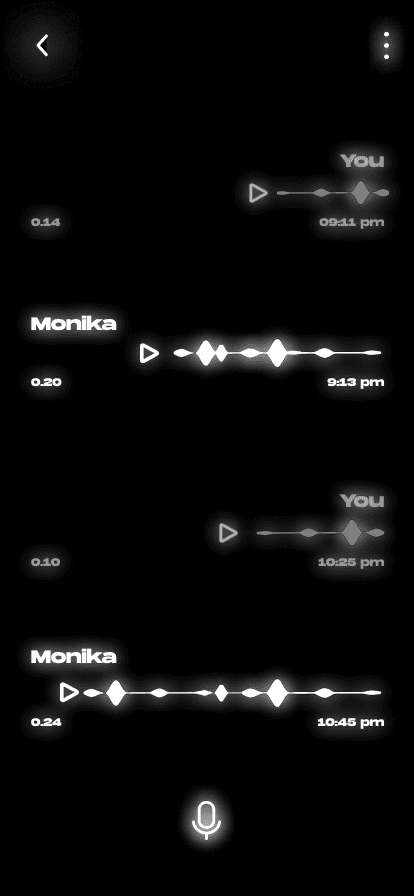
Conversations in voice
Messages are voice notes with timestamps and durations, not text. You hear tone, hesitation and humour, the things a photo or a typed message hides.
/04
Clickable prototype
Tap through the concept from the first screen to a voice conversation.
Reflection
A speculative piece, meant to provoke questions rather than ship.
/01
What it questions
If first impressions were made by voice, would we choose differently? Inkognito uses an extreme visual restriction to make that question tangible.
/02
Open questions
Voice is personal data too. A real version would need consent around recordings, safety tools for unwanted messages and a clear answer to when, and whether, faces are revealed.
© More works
(WDX®)
digital design


© help centre
(WDX)
clarification









Let’s talk